Architecture Overview
Artesian is a multi-agent context orchestration system: pluggable memory, optional orchestration (master/worker/judge), optional task tracking, and optional sandboxing — all non-intrusive. It integrates with agents over MCP, so any MCP-capable tool (Claude Code, Codex, Zed, opencode, …) gains Artesian's capabilities without changing how it is driven. You adopt only what you want via modes.
This page is the map; each concern has its own doc.
System map
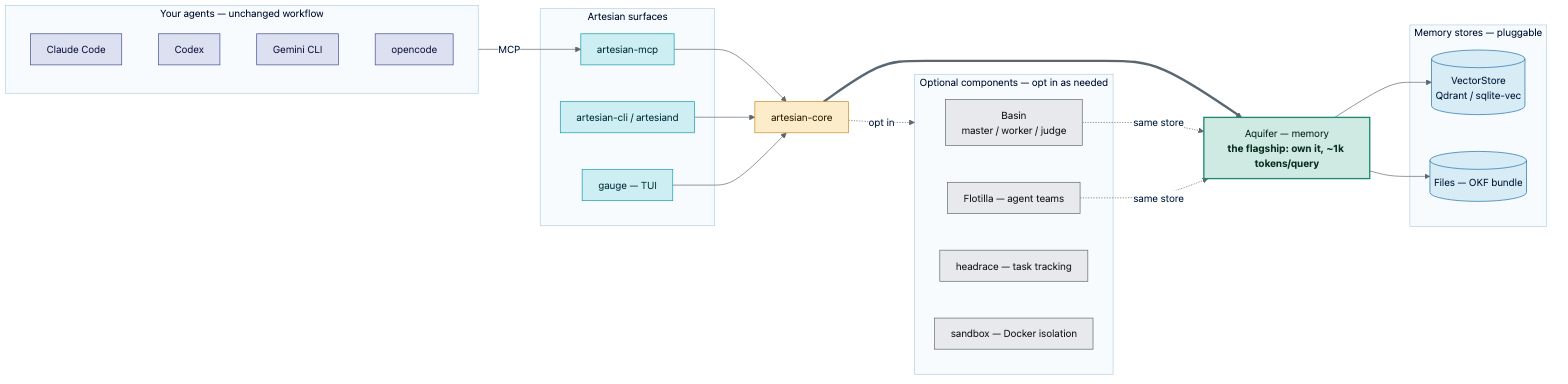
Crates (strict boundaries, trait seams)
| Crate | Responsibility |
|---|---|
artesian-core |
roles (master/worker/judge), task-queue types (Job/Queue/CompletedJob), config, modes, the Agent adapter trait, the event envelope |
aquifer |
memory: MemoryBackend, the VectorStore seam, VectorMemoryBackend<V>, RRF, tiers, OKF files |
headgate |
ACC control plane: RecallStore data-plane seam, QualifyGate, bounded CommittedContextState, commit-loop controller, GaugeMetrics; feature llm adds the LLM judge-eval gate, CouncilJudge (panel + arbiter), LLM compressors, and local provider aliases (Ollama/LM Studio/mlx); feature headroom adds HeadroomCompressor adapter |
headrace |
task tracking: TaskStore (Files/Vector/External), the task DAG |
artesian-mcp |
exposes tools over MCP (memory.*, tools.find, task tools); the agent integration point |
artesian-cli / artesiand |
user entrypoint + optional daemon (init, memory ops, spawn, pooling) |
gauge |
evaluation harness: LoCoMo/LongMemEval recall benchmarks, agentic task scoring (memory-guides-action), footprint/accuracy/token metrics, LLM-as-judge eval (see acc-bench.md) · sandbox optional Docker sandbox |
Engine/agent/tracker specifics live behind traits (VectorStore, Agent, TaskStore,
MemoryBackend, RecallStore, QualifyGate, Compressor) so adding a backend, agent, tracker,
retrieval store, gate, or compressor is a small adapter, never a core change.
Cross-cutting concerns (read the focused docs)
- Memory — short/long-term, retrieval math (cosine, RRF k=60), tiers L0–L3, OKF on-disk format, optional rerank/HyDE/consolidation. → memory.md
- Concurrency & multi-tenancy — many agents/users in parallel; append-mostly idempotent writes, project-per-collection + payload tenancy, backend-by-concurrency. → concurrency.md
- Orchestration & coordination — roles, topologies, router (agent + semantic tool selection), event envelope, coordination mechanisms, worker workspace isolation, verifiers, observability. → orchestration.md
- Task tracking — DAG with dependencies, hierarchical decomposition, md/vector/external (Jira/Linear). → task-tracking.md
- Self-repair — surviving auto-compaction via a deterministic anchor + recall. → self-repair.md
- Modes —
memory|orchestrate|full|advanced(BYO). → modes.md - Context tree — layered, priority-ordered AGENTS/CLAUDE md. → context-tree.md
- Build & contribute — development.md
Design invariants
- Non-intrusive default.
memorymode adds onlymemory.find/memory.storeover MCP; the agent workflow is unchanged. Anything costing an LLM call or latency is opt-in, off by default. - MCP-first. One universal integration surface for every agent tool.
- Trait seams, thin adapters. Backends/agents/trackers are pluggable; the core is engine- agnostic.
- Append-mostly, idempotent memory. No read-modify-write on points ⇒ safe concurrency.
- Single mutation authority + blackboard. Agents coordinate indirectly through shared memory + the task DAG, not token-heavy chatter; one authority serializes state changes.
- Verifiers define trust. The judge commits only when configured verifiers pass.