Basin — Orchestration (master / worker / judge)¶
Basin is the well of the Norns, where fate is decided. Artesian's orchestrator decides who does what, when, and whether the work is accepted.
Orchestration is opt-in (orchestrate/full modes). If you only want memory, skip this — your
agent workflow is unchanged. When enabled, Artesian coordinates multiple agent invocations through a
shared blackboard (memory + task queue) rather than chatty direct messaging, which is the
token-efficient MAS pattern.
Status: [implemented: core loop] — Phase 2.5 ships the default blackboard loop: dispatch
eligible task-DAG nodes, run isolated workers, store worker learnings, gate through verifiers and
optional judge review, emit events/run-log token accounting, and transition to done only after
the judge gate passes. Debate/router/Contract-Net/pipeline remain config-selectable seams.
Roles¶
| Role | Job | MAS pattern |
|---|---|---|
master |
plan, decompose, decide when to delegate, "listen" for results | manager |
worker |
execute one task; write code, not commits | worker |
judge |
review against gates (tests/lint); the only committer (CompletedJob) |
critic / gatekeeper |
Roles are composable: master-judge only, one agent bound to all roles (e.g. Codex everywhere), or the full triad. The master spends its tokens planning and launches the worker so the worker's tokens do the heavy lifting, then the judge gates the result — an agentic loop with a quality gate.
Verifiers define the boundary of trust¶
The judge does not "vibe-accept" — it gates on configurable verifiers: concrete, deterministic
checks the work must pass before reaching done/commit (CompletedJob). Typical verifiers: test suite,
linter, type-check, build, format. Verifiers are declared in config; only when they pass is the
worker's output trusted enough to commit. This is what makes long-running autonomy safe: the
breadth of what an agent may do unattended is exactly the breadth your verifiers cover. Durable
loops (worker → verifier → judge → retry) turn this into self-correcting autonomy.
Visual artifacts as control surfaces¶
Long-running agents are steered through visual artifacts, not transcripts: the task board (headrace), the TUI (Gauge), an optional macOS tray (Tray), and the OKF HTML visualizer over the memory bundle (see memory.md §4.1). External mirrors (Jira/Linear) give the same board in a familiar UI. These surfaces let a human glance, redirect, and approve without reading raw logs.
Coordination by shared blackboard (not chatter)¶
Agents do not stream long messages to each other (expensive, lossy). They coordinate indirectly through shared state — the recommended token-efficient MAS topology:
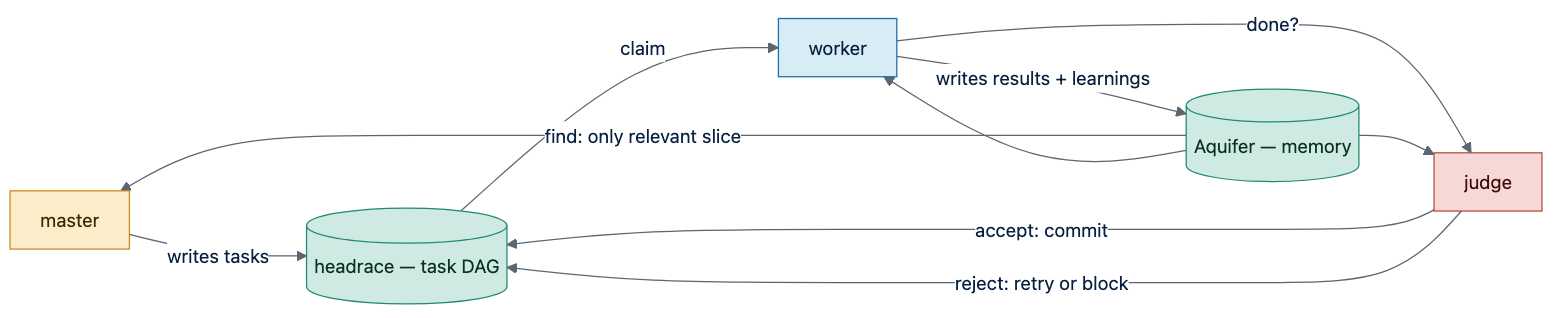
A single mutation authority serializes task-state changes (anti-race; from Symphony). The
blackboard is the task DAG (headrace) plus long-term memory (Aquifer); each agent reads only the
slice it needs via memory.find, never the whole history.
Coordination & communication primitives¶
Even with blackboard coordination, the records exchanged need a defined shape. Artesian standardizes a small event envelope (JSON, LLM-parseable) so any agent adapter and the observability layer speak the same language — inspired by agent communication languages (FIPA ACL) but minimal:
{
  "id": "evt-…", "correlation_id": "erindi-…", "timestamp": "2026-06-14T00:00:00Z",
  "sender": {"role": "master", "agent_id": "…"}, "protocol_version": "0.1",
  "type": "TASK_ANNOUNCED | TASK_CLAIMED | RESULT | VERDICT | BLOCKED | STATUS | ERROR",
  "payload": { }
}
correlation_id links a result/verdict back to its task (no need to replay history). Events are
represented by artesian-core::EventEnvelope and are intended for the blackboard (headrace/memory) and
run log.
Coordination mechanisms (the orchestrator is a centralized coordinator by default — simplest, one authority):
- Task allocation — role bindings by default; optional capability routing via the Router; an optional Contract-Net mode (announce → workers bid → award) for capability markets.
- Synchronization — the task DAG encodes dependencies; a barrier (a synthesis task) waits for all parallel sub-tasks before proceeding; claim/complete are events.
- Resource management — shared resources (model rate limits, API keys, DB connections) are
governed by quotas/scheduling: per-agent/per-user token budgets and rate limits, connection
pooling funneled through
artesiand(see concurrency.md). - Consensus (optional) — debate/critique or simple voting among multiple critics when one judge is not enough.
Worker workspace isolation (required for parallel workers on one project). Each worker runs in
an isolated workspace (a git worktree or scratch directory) so concurrent workers on the same
repo do not clobber each other's files; results are integrated only through the judge gate. This is
the file-level complement to the memory concurrency model, and it composes with the optional
sandbox Docker sandbox.
Observability. Every event carries id/correlation_id/timestamp/sender; the orchestrator
emits structured run logs and per-agent/session token accounting, so multi-agent runs are
debuggable and the evaluator/judge has evidence to gate on.
Topologies (config, hybrids allowed)¶
Artesian supports the standard collaborative architectures; pick per project, compose freely:
- Hierarchical team (default, core loop implemented) — task DAG → workers execute → judge gate accepts/retries/blocks. Master decomposition remains a seam before dispatch.
- Debate / critique — proposer + critic iterate to a quality bar (the judge loop generalized).
- Router / dispatcher — a router classifies a task and routes it to the best specialist agent (mixture-of-experts). See below.
- Pipeline — sequential stages, output→input.
Runtime entrypoints¶
artesian run / artesian orchestrate runs the loop in the foreground. artesiand runs the same loop as
a daemon-style foreground process. Both are strictly gated to orchestrate or full mode; memory
mode returns without orchestration side effects. --dry-run uses mock agents and still exercises
task planning, dispatch, event emission, verifier gates, and memory writes without launching real
agent CLIs.
Process-backed agents are supervised. Each worker/judge subprocess is launched in its own process
group, recorded under coordination.spawn_registry_path (default .artesian/spawns), and terminated
as a whole group on success, timeout, cancellation, verifier rejection, quota exhaustion, SIGINT,
SIGTERM, or adapter drop. Shutdown is SIGTERM, coordination.spawn_shutdown_grace_millis of grace,
then SIGKILL. Startup reaps registry entries whose owning Artesian process is no longer alive, so a
crashed daemon does not leave orphaned agent trees behind.
Spawn ceilings are config-gated:
[coordination]
concurrency_limit = 2
max_concurrent_spawns = 32
spawn_max_lifetime_seconds = 1800
spawn_shutdown_grace_millis = 2000
spawn_registry_path = ".artesian/spawns"
concurrency_limit controls task dispatch. max_concurrent_spawns is the hard process cap enforced
by the process adapter; new subprocesses are refused once the cap is reached.
spawn_max_lifetime_seconds is a global per-spawn watchdog and is applied in addition to each agent
binding's timeout_seconds.
Agent/model bindings¶
Each role binds to an agent CLI and may also bind to a concrete model:
[[agents]]
role = "master"
agent = "claude"
model = "claude-opus"
command = "claude"
args = ["--model", "{model}", "--print", "{prompt}"]

[[agents]]
role = "worker"
agent = "claude"
model = "claude-sonnet"
command = "claude"
args = ["--model", "{model}", "--print", "{prompt}"]

[[agents]]
role = "judge"
agent = "codex"
model = "gpt-5.5"
command = "codex"
args = ["exec", "--model", "{model}", "{prompt}"]
The same binary can therefore back multiple roles with different models. {role}, {alias},
{agent}, {model}, and {prompt} are rendered by artesian-process-agent immediately before the
supervised subprocess launch. If model is set, Artesian validates it against the agent catalog
before spawning; unavailable models fail early and do not create a process-tree registry entry.
artesian agents refresh probes configured agents and writes the cached catalog to
<memory.root>/agents.json:
{
  "generated_at": "1781540000000",
  "agents": [
    {
      "agent": "codex",
      "command": "codex",
      "reachable": true,
      "last_checked": "1781540000000",
      "models": [
        { "id": "gpt-5.5", "reachable": true, "source": "static-fallback" }
      ]
    }
  ]
}
If an entry is not reachable, unreachable_reason is one of no-command, no-credentials,
quota, network, or unknown. last_checked lets callers decide whether to refresh stale
catalog data.
Discovery order is: an optional agent-specific CLI list command (ARTESIAN_<AGENT>_MODELS_CMD),
provider-specific discovery hooks where credentials exist, curated static fallbacks for known
agents, and a cheap reachability probe for the configured command. Cache files are written with
restrictive permissions where the platform supports it.
Credential handling contract¶
Artesian treats model/provider credentials as external runtime state:
- reuse the provider session or CLI credentials the operator already configured;
- do not collect or persist tokens unless the operator explicitly provides a storage path or secret manager;
- if a future adapter must persist a token, use restrictive file permissions (
0600) and the OS keychain or platform secret store where available; - never log provider credentials, environment variables, full command environments, or raw subprocess command lines;
- subprocess failure output is redacted and truncated before it appears in errors or run logs.
This contract applies to discovery, reachability probes, spawned role agents, and MCP delegation.
MCP orchestration tools¶
When artesian-mcp is started from a config in orchestrate or full mode, it exposes orchestration
tools in addition to memory tools. In memory mode these routes are disabled and do not appear in
tools/list.
agents.list() -> { catalog }orchestrate.bind({ role, agent, model, command?, args?, timeout_seconds? }) -> { binding }orchestrate.delegate({ role, task }) -> { task_id, status, role, agent, model, result? }orchestrate.status({ task_id }) -> { task_id, status, result? }orchestrate.handoff({ to, task_id?, content }) -> { accepted, to }
Delegation always uses the configured ProcessAgent path, so process-group cleanup, registry
reaping, spawn caps, per-spawn timeouts, and max-lifetime watchdogs are inherited from the normal
orchestration runtime.
artesian init writes a short master role prompt under the memory root. The prompt tells an
in-session master to call agents.list, recall with memory.context, delegate bounded subtasks via
orchestrate.delegate(worker), and hand results through orchestrate.handoff before accepting
durable outcomes.
Cheap/local coordinator pattern¶
The master/coordinator role can be bound to a cheap or local model, for example an Ollama small model, because coordination can be mostly routing, queue management, and synthesis of already retrieved context. This is an opt-in binding pattern, not a default recommendation: keep verifier gates and judge roles strong enough for the project risk, and validate quality empirically before standardizing on a cheap coordinator.
Agent adapter provider guide¶
Adding a new agent such as OpenClaw or pi should not require core changes. Implement the
Agent trait: spawn, send, stream, capabilities, and list_models. Artesian supports two
integration modes:
- Artesian spawns the adapter as a role agent through supervised orchestration.
- The agent consumes Artesian's MCP memory/orchestration tools as a peer and keeps its own process lifecycle.
The default ProcessAgent adapter is enough for CLIs that accept prompt/model arguments. Native
adapters are only needed when a CLI has richer session semantics, streaming events, or model
discovery APIs that are worth exposing directly.
Provider authors should keep detection lean:
- check
PATHand a small, documented set of known config directories such as~/.codex,~/.claude, or~/.config/<agent>; - do not crawl home directories and do not read credential files during passive detection;
- implement
list_modelswith the provider's own list-models command first, then an API query only when credentials are already present; - return typed unreachable reasons instead of dumping provider errors;
- pass every spawn through the supervised
ProcessAgentpath unless the adapter implements an equivalent process-tree lifecycle guarantee.
Router — agent routing and tool selection (token-saver)¶
Two routing problems, one embedding-backed mechanism (reuses Aquifer's embedder):
- Agent routing — given a task, route it to the most suitable agent/role/specialist (e.g. a cheap OSS model for formatting, a frontier model for planning). Right-sizing the model per sub-task cuts cost.
- Semantic tool selection — when an agent has many MCP tools, including every tool
description in the prompt is wasteful. Artesian can return only the relevant subset for the
current task (
tools.find), materially cutting prompt tokens. This is opt-in (coordination.router_enabled = true) and directly serves Artesian's token-economy mission.
flowchart LR
  T[Task / sub-task] --> R[Router: embed + classify]
  R -->|route| A[best specialist agent]
  R -->|select| TS[relevant tools only]
Tasks are a DAG (parallelism + targeted retry)¶
Decomposition produces a directed acyclic graph of sub-tasks, not just a list: dependencies are edges, independent sub-tasks run in parallel workers, and a failed sub-task is retried in isolation without restarting the whole plan. Hierarchical decomposition refines compound tasks into primitive (directly executable) ones. See task-tracking.md.
Cost discipline (MAS scales by tokens)¶
Many agents = communication/token overhead. Artesian's defaults keep it cheap: indirect blackboard
comms, memory.find slices instead of full-history replay, the master "listening" while the
worker spends, parallel independent sub-tasks, right-sized models per role, and embedding/result
caching. Orchestration never becomes the bottleneck the literature warns about.
References¶
- Wooldridge, An Introduction to MultiAgent Systems (2nd ed., 2009) — MAS structures and coordination.
- Hong et al., MetaGPT (2023) — role-based agents, structured comms, SOPs. https://arxiv.org/abs/2308.00352
- Russell & Norvig, AIMA Ch. 11 (Planning) — Hierarchical Task Networks.
- Yao et al., Tree of Thoughts (NeurIPS 2023) — decomposition/search. https://arxiv.org/abs/2305.10601
- Patil et al., Gorilla (2023) — scaling tool invocation. https://arxiv.org/abs/2305.15334
- Wang et al., A Survey on LLM-based Autonomous Agents (2023). https://arxiv.org/abs/2308.11432
- Smith, The Contract Net Protocol (IEEE TC, 1980) — negotiated task allocation. https://doi.org/10.1109/TC.1980.1675516
- FIPA ACL (FIPA, 2002) — agent communication language / message acts (standard reference).
- Wu et al., AutoGen (2023) — multi-agent conversation/coordination patterns. https://arxiv.org/abs/2308.08155
- ApX, Agentic LLM Systems & Memory Architectures, Chapters 4–5 — planning, tools, MAS. https://apxml.com/courses/agentic-llm-memory-architectures