Aquifer — Artesian Memory Architecture¶
An aquifer is a saturated layer that holds water under pressure and yields it on demand. Artesian's memory subsystem is the well your agents draw from before they act.
This document describes how Artesian models, stores, and retrieves agent memory: the taxonomy (short-term vs long-term), the concrete data model, the retrieval mathematics as actually implemented, the pluggable backend seam, and the self-repair mechanism that survives context auto-compaction. Formulas here match the code; each section links to the implementing file.
Status legend: [implemented] = present in crates/aquifer; [planned] = designed,
not yet built (tracked in the roadmap).
1. Why memory¶
An LLM call is stateless: the model only sees its context window of size $L_{context}$. Two pressures follow for any agent that runs longer than one prompt:
- Recall beyond $L_{context}$ — facts, decisions, and past work exceed the window.
- Token economy — replaying whole project docs into every session is expensive and crowds out reasoning budget.
Artesian's thesis: replace replaying everything with retrieving only what is relevant. A targeted recall of a few hundred tokens substitutes for thousands of tokens of re-read context, which is both cheaper and more focused. This is the same lever the Artesian project itself was created to pull.
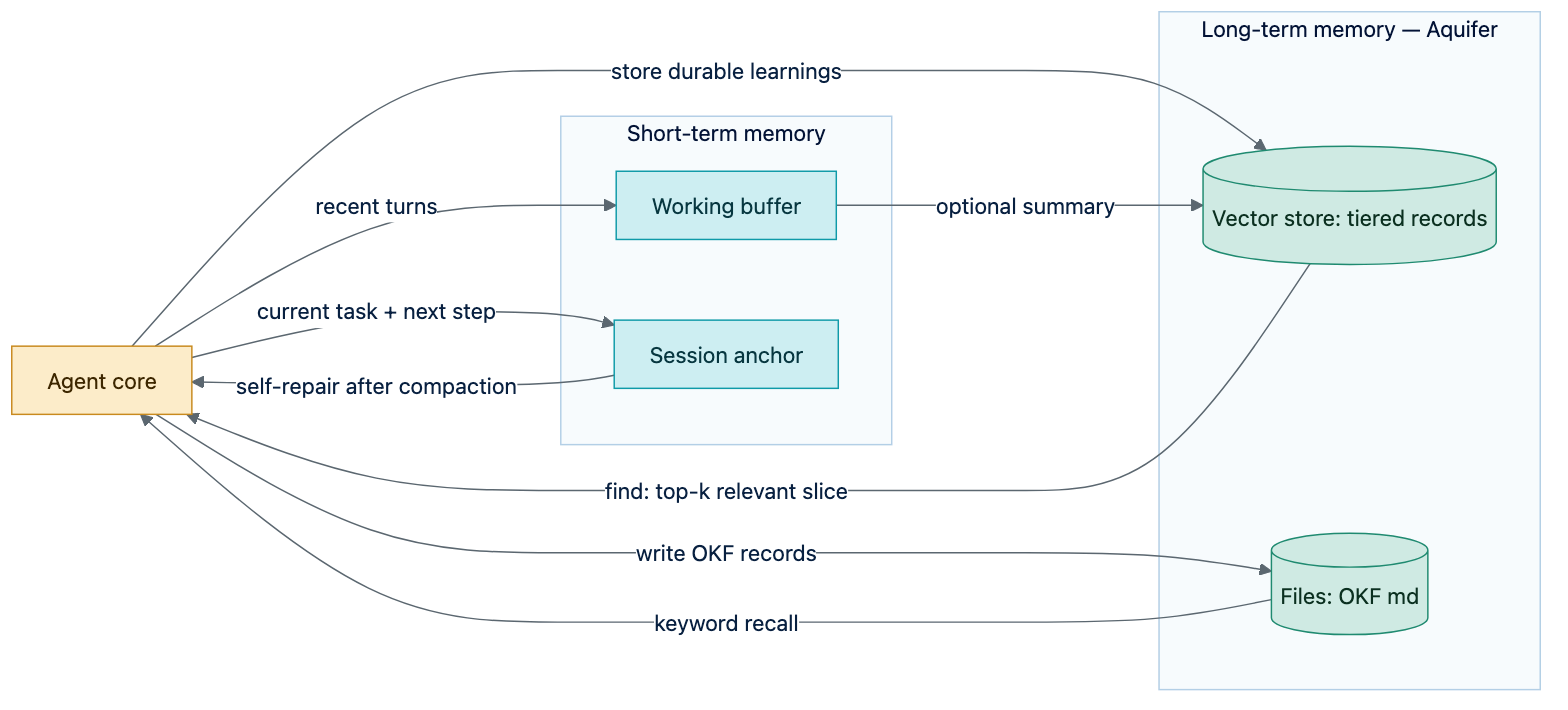
Design principle — cheap by default, smart on demand. The default memory path is local: structural import, an
index.mdcatalog, embedding retrieval, RRF, and a local reranker seam where enabled. It makes no extra LLM calls and adds zero provider tokens. Every sophistication that costs an LLM call (HyDE, LLM multi-query, reflection consolidation, debate/critique) is opt-in and off by default, so "memory mode" never changes how you drive your agent — it only makes it cheaper and sharper.
2. Taxonomy and data model¶
Artesian follows the standard agent-memory split (short-term working memory vs long-term persistent memory; see references) and layers a TencentDB-style tiering over long-term records.
Every long-term unit is a MemoryRecord (crates/aquifer/src/types.rs):
| Field | Meaning |
|---|---|
id |
content-derived stable id (dedup key) |
node_id |
deterministic handle for drill-down from a summary to ground truth |
content |
the embedded text |
tags, metadata |
filterable payload (incl. tenancy: scope/agent_id/session_id/task_id/user_id — see concurrency.md) |
tier |
L0Raw | L1Atom | L2Scenario | L3Project |
created_at |
timestamp (date-tagged on disk) |
Memory tiers (MemoryTier) implement progressive abstraction so high-level summaries stay
traceable to evidence:
flowchart TD
  L0["L0Raw — raw logs / transcripts"] --> L1["L1Atom — atomic facts"]
  L1 --> L2["L2Scenario — aggregated scenarios"]
  L2 --> L3["L3Project — distilled project/persona knowledge"]
  L3 -. node_id drill-down .-> L0
A consumer asks at a high tier (cheap, dense) and uses get_node(node_id) to pull the exact
ground-truth record only when needed — "context offloading" that keeps prompts small.
3. Long-term memory — semantics and math [implemented]¶
3.1 Embeddings¶
Text is embedded into a dense vector $e = f(\text{text})$ with a pinned model so vectors are
comparable across every machine and backend
(crates/aquifer/src/vector_memory.rs):
- model
intfloat/multilingual-e5-small, $d = 384$ dimensions, multilingual (RU/EN); - E5 requires asymmetric prefixes — Artesian embeds queries as
query: …and stored passages aspassage: …(FastembedTextEmbedder::embed_query/embed_passage). Skipping the prefixes measurably degrades E5 recall, so this is enforced in one place.
3.2 Semantic similarity¶
Relevance between a query embedding $q$ and a record embedding $d$ is cosine similarity (the
configured Distance::Cosine):
\mathrm{sim}(q, d) = \cos\theta = \frac{q \cdot d}{\lVert q\rVert\,\lVert d\rVert}
= \frac{\sum_{i=1}^{384} q_i d_i}{\sqrt{\sum_{i=1}^{384} q_i^2}\,\sqrt{\sum_{i=1}^{384} d_i^2}}
Range $[-1, 1]$; higher means more semantically related. The vector store performs approximate nearest-neighbour (ANN) search to return the top-$k$ records by this metric without scanning every point — single-digit milliseconds at Artesian's scale.
3.3 Hybrid retrieval via Reciprocal Rank Fusion¶
Pure vector search misses exact tokens (identifiers, error codes); pure keyword search misses
paraphrase. Artesian runs both channels and fuses them with Reciprocal Rank Fusion
(crates/aquifer/src/rrf.rs). For a document $d$ appearing at rank $r_c(d)$ (1-based) in
channel $c$:
\mathrm{RRF}(d) = \sum_{c \in \{\text{keyword},\,\text{vector}\}} \frac{1}{k + r_c(d)},
\qquad k = 60
The code computes 1.0 / (rank_constant + rank + 1.0) with 0-based rank and
rank_constant = 60 (RrfOptions::default, types.rs), i.e. exactly $1/(k + r_c)$ with 1-based
$r_c$. Documents are summed across channels, sorted by fused score (ties broken by node_id for
determinism), and truncated to the limit.
Why RRF and $k=60$: RRF needs only ranks, not calibrated cross-channel scores, so a BM25 score and a cosine score combine without normalization; $k=60$ is the original constant from Cormack et al. (2009) and damps the influence of low ranks. This is why one fusion function works unchanged across every backend.
3.4 Retrieval and store flows¶
sequenceDiagram
  participant Ag as Agent
  participant VM as VectorMemoryBackend
  participant Em as Fastembed (e5-small)
  participant VS as VectorStore (qdrant / sqlite-vec)
  Ag->>VM: find(query)
  VM->>VS: keyword search (BM25/payload)
  VM->>Em: embed_query("query: …")
  VM->>VS: vector ANN search (cosine)
  VM->>VM: reciprocal_rank_fusion([kw, vec], k=60)
  VM->>VS: fetch sibling chunks (parent_node) of matched chunks
  VM->>VM: small-to-big expand + dedup (adaptive budget)
  VM-->>Ag: k SearchHit (parent-section window, score, source=hybrid)
  Ag->>VM: store(memory)
  VM->>VM: chunk_text(content) — recursive, bounded chunks
  loop per chunk
    VM->>VM: stable_memory_id (content hash) — dedup
    VM->>Em: embed_passage(chunk)
    VM->>VS: upsert(point{id, vector, payload, parent_node})
  end
store is idempotent: stable_memory_id hashes content, and an existing id short-circuits the
upsert (vector_memory.rs), so re-running a backfill never duplicates. This gives the
idempotency the literature calls for in heterogeneous memory writes.
3.5 Chunking + small-to-big — bounded, coherent recall [implemented, default]¶
On store, records are split into bounded chunks (chunking::chunk_text, deterministic and
zero-LLM): it splits recursively on the most semantic boundary available (markdown heading → blank
line → line break → sentence → a hard character window only as a last resort), packing pieces up to
~400 tokens with a small overlap so context carries across boundaries. Each chunk is its own
retrievable record with parent linkage — parent_node, node id <parent>#chunk-N, and
chunk_index/chunk_count. Small content yields a single chunk and keeps the original id, so
dedup/idempotency is unchanged.
On read (small-to-big), matching happens on the precise small chunk, but find returns the
surrounding parent-section context: contiguous sibling chunks of the same parent_node, merged
with the chunker overlap removed, grown symmetrically around the match. Several matched chunks of
one parent collapse into one expanded hit whose node_id is the parent — so a result set is
k distinct sources, not k fragments — and the complete document stays one get_node(parent)
drill-down away (reconstructed from its siblings). This is the small-to-big / parent-document
pattern: match precisely, return coherent context.
The expansion is bounded by an adaptive budget (parent_context_*). By default
(parent_context_auto) the budget is the median size of multi-chunk parent documents observed
on the collection, clamped to [chunk size, parent_context_max_chars] (8192 ≈ ~2k tokens) and
falling back to a fixed parent_context_chars (3200) until the corpus is seen. So the window
self-calibrates: a corpus of cohesive multi-KB notes returns whole sections, while a corpus with
huge outliers caps per-source context and leaves the rest to drill-down. Single-chunk records have
no siblings, so expansion is a no-op for them — small-document recall is unchanged.
Recall is therefore bounded by budget × distinct sources, not by record size, and there is no content truncation on the read path: the relevant passage is returned inside coherent surrounding context, never an arbitrary prefix. This is why the benchmark keeps per-query cost bounded — small-to-big windows, not whole documents — even as the durable memory grows past a million tokens.
Atomic-fact distillation (opt-in, LLM)¶
Structural chunking is zero-LLM and the default. For noisy conversational sources it can leave
dangling references — "he", "it", "last Friday" — that retrieve poorly in isolation. The opt-in
artesian memory distill pass (an AtomMem-style "fact executor") rewrites raw text into
self-contained atomic facts: every pronoun resolved to its named entity and every relative date
anchored to an absolute one, one durable fact per line, with role-marker neutralization so untrusted
text cannot inject instructions. It costs one LLM call per text — point [acc.compressor] (or
[acc.judge]) at a local Ollama / LM Studio for zero token cost — and --store files each fact as a
fact-tagged atom. Use it to seed a value-dense store from transcripts; structural chunking remains
the default for code and docs.
3.6 Retrieval enhancements¶
The default path stays cheap and non-intrusive. Artesian now exposes these measurable stages:
- Two-stage reranking [implemented seam] — retrieve a wider candidate set of $M \gg k$ by RRF,
then re-score through the
Rerankertrait.LocalLexicalRerankeris deterministic and cheap for tests;FastembedRerankerwraps a local fastembed cross-encoder behind the vector feature. No API or LLM call is made. - Index-first context [implemented] —
memory.contextreturns a compactindex.mdslice and targetedmemory.findhits, matching the read-first catalog pattern from LLM-wiki. - Entity-overlap channel [implemented, opt-in] — extract entities deterministically and fuse an entity-overlap signal alongside keyword + vector in RRF, linking records that share entities.
- Temporal signals [implemented, opt-in] — recency-weighted scoring ($S \times e^{-\lambda \Delta t}$) and knowledge-update supersession (a newer record about the same entity wins for recall; the older stays as drillable history).
- Episodic context expansion [implemented, opt-in] — cluster records into coherent episodes and expand a hit with a small window of its episode-mates for continuity.
- HyDE [opt-in LLM cost] — embed a hypothetical answer $d_{hypo} = \text{LLM}(q)$ instead of the bare query, to close the query-document vocabulary gap.
- Multi-query [opt-in LLM cost] — expand $q$ into ${q_1..q_N}$, search each, merge+dedup for topic coverage.
- Debate/critique [opt-in LLM cost] — answer-time proposer/critic loop, reusing the judge seam.
These map onto the same VectorStore/RRF stack; only the query/scoring stage changes. Each opt-in
signal ships off by default and is enabled only where a target corpus shows a measured retrieval
gain (precision/recall) — measured against the benchmark, not assumed.
4. Pluggable backends [implemented]¶
Memory is engine-agnostic. The top contract is MemoryBackend
(crates/aquifer/src/backend.rs); the vector engines sit behind the thin VectorStore seam
(crates/aquifer/src/vector.rs) and the generic VectorMemoryBackend<V> writes embedding,
tiering, RRF, and payload schema once for all of them.
flowchart TD
  MB[trait MemoryBackend] --> FB[FilesBackend — md, date-tagged]
  MB --> VMB["VectorMemoryBackend<V: VectorStore>"]
  VMB --> QS[QdrantVectorStore]
  VMB --> SS[SqliteVecVectorStore]
VMB -. future .-> TS[TencentDBVectorStore]| Backend | Keyword channel | Vector channel | Hybrid | Infra |
|---|---|---|---|---|
FilesBackend |
substring over md | — | n/a (keyword only) | none |
SqliteVecVectorStore |
FTS5 BM25 | vec0 cosine |
RRF (client) | none (embedded) |
QdrantVectorStore |
payload match¹ | HNSW cosine | RRF (client) | Qdrant server |
¹ Both vector backends currently report supports_server_side_hybrid = false
(sqlite_vec.rs, qdrant.rs), so fusion runs client-side via RRF. capabilities() is the seam
for future server-side fusion (Qdrant Query-API / sparse vectors); when a backend sets the flag,
VectorMemoryBackend::hybrid_rrf delegates to the engine instead. sqlite-vec already gives a true
BM25 keyword channel; Qdrant's keyword channel stays payload-match until sparse/BM25 is added
[planned].
The normalized Filter (eq/in/range/exists with must/should/must_not,
types/vector.rs) is the only query DSL consumers touch; each adapter translates it to native
filters. Engine specifics (metric names, id types, index knobs) never leak above VectorStore.
4.1 On-disk format: Open Knowledge Format (OKF)¶
The FilesBackend stores memory as a directory of markdown files — Karpathy's
"LLM wiki" pattern
(index.md catalog read first, log.md history, interlinked entity/concept pages, maintained by
ingest/query/lint). Artesian
aligns this on-disk format with the Open Knowledge Format (OKF) (Google Cloud, Apache-2.0): a
vendor-neutral spec that is just markdown, just files, just YAML frontmatter, git-friendly and
readable with cat, with no vector-DB dependency. Adopting OKF makes Artesian's file memory
interoperable with the wider OKF ecosystem (e.g. the OKF static HTML graph visualizer — a free
visual control surface over memory) and standardizes the md ↔ vector import/export.
OKF requires exactly one frontmatter field, type; Artesian keeps its own fields as allowed
extensions (consumers tolerate unknown keys):
---
type: decision            # OKF: concept kind (memory|decision|runbook|reference|…)
title: RRF k constant     # OKF recommended
description: Why k=60      # OKF recommended
tags: [retrieval, rrf]    # OKF recommended
timestamp: 2026-06-14T00:00:00Z   # OKF recommended (== created_at)
node_id: node:abc         # Artesian extension (drill-down handle)
tier: l2-scenario         # Artesian extension (L0–L3)
---
Body markdown; relationships are plain links to other concepts ([k=60](/retrieval/rrf.md)).
Reserved files follow OKF: index.md (directory listing) and log.md (chronological update
history — also where the self-repair anchor log lives, see §6). FilesBackend now writes
YAML --- OKF files and keeps a backward-compatible reader for legacy TOML +++ records.
Ref: OKF v0.1 spec (Apache-2.0).
The OKF files are the source of truth; the index is a rebuildable projection¶
The durable, human-readable OKF markdown is the append-only source of truth; the vector/search
index is a derived projection you can throw away and rebuild from those files at any time — the
same event-sourcing discipline as a CQRS read model. So memory stays auditable (cat the files,
git diff the history) and is never trapped in a database. Two operations make this concrete:
artesian memory rebuild [--from <okf-dir>]re-indexes every OKF file into the configured backend transactionally (idempotent, content-hash dedup) — the Artesian equivalent of dropping and rebuilding a read model. Run it after bulk-editing files, after switching/upgrading a vector engine, or to recover an index from the files alone.- For the bounded committed-state layer, the OCF bundle pairs
a
snapshot.jsonwith aqualify.jsonlgovernance log — the append-only admit/reject trail behind what is in force — so why each entry was committed is replayable too.
4.2 Structured / graph memory [planned, future]¶
Vector search finds similar text; some questions need exact relations ("which tasks block
X?", "what did decision D change?"). A future StructuredMemory backend (behind the same
MemoryBackend contract) will hold a knowledge graph (entities + edges) and/or relational rows,
queried precisely (Cypher/SQL) and used hybrid with vectors: semantic search to find a region,
then a structured query for exact facts (entity linking, KG-augmented retrieval). The current
node_id drill-down + L0–L3 tiers are already a lightweight graph; a full KG is the next step.
Any generated query runs read-only/validated (injection-safe). Ref: Hogan et al., Knowledge
Graphs (2021).
5. Short-term memory¶
Long-term memory answers "what do we know"; short-term memory answers "what are we doing right
now". Artesian provides three standard mechanisms behind a WorkingMemory seam:
- buffer — full recent turns (highest fidelity, smallest horizon);
- sliding window — last $k$ turns, bounded prompt contribution;
- summary buffer — keep recent turns verbatim and emit older turns as a pending
L2Scenario/L3Projectmemory only whensummarize_tois configured. The default buffer and sliding-window modes perform no LLM calls and add no tokens.
flowchart LR
  T[New turn] --> WB[Working buffer]
  WB -->|len > k| SW[Sliding window: keep last k]
  SW -->|older turns| SUM[Summarize]
  SUM -->|write as L2/L3 record| LTM[(Long-term memory)]
The consolidation path is opt-in; by default, short-term memory is an in-process buffer/window.
6. Self-repair across auto-compaction¶
Long sessions hit auto-compaction: the host summarizes/truncates context and the agent can lose
its place. Artesian makes this a non-event (see docs/self-repair.md):
- Session anchor (Anchor) — a tiny, always-current record of the in-flight task, the plan pointer, the last N decisions, and the next concrete step. Cheap to write every turn.
- Continuous externalization — durable learnings are flushed to long-term memory as they
occur, so truncation loses nothing recoverable via
find. - Self-repair hook — on a detected compaction/resume boundary the agent re-reads the anchor
(deterministic) and runs a targeted
find(semantic) before its next action — no manual "re-read the docs" step.
flowchart LR
  C{Compaction / resume?} -->|yes| RA[Read session anchor]
  RA --> RC["find(current task) — top-k recall"]
  RC --> ACT[Resume exact next step]
  C -->|no| ACT
The deterministic anchor handles "what is my current step" (vector search is too fuzzy for that); the semantic recall restores the surrounding knowledge. Together they make a switch between agents (e.g. Claude Code → Codex) lossless.
Implemented surfaces:
- MCP:
memory.anchor.get/memory.anchor.set - CLI:
artesian memory anchor get|set|recover - File: the current session anchor is appended to OKF
log.md
7. Token-efficiency rationale¶
Let a project's full re-read context cost $T_\text{full}$ tokens. Replaying it every session of a
multi-session task of $N$ sessions costs $\approx N \cdot T_\text{full}$. Retrieval instead
injects only the matched sources expanded to their parent sections, $\approx k \cdot b$ tokens
($k$ = distinct sources, $b$ = the small-to-big budget, capped at parent_context_max_chars),
plus the anchor $T_a \ll T_\text{full}$:
Tiering compounds this: high-tier (L3Project) records are dense summaries, and get_node
drill-down fetches raw evidence only on demand, so the common path pays for summaries, not
transcripts. Local embedding (fastembed) adds bounded latency (~10–50 ms/query) and zero
tokens, so the retrieval path is a net token win, not a cost.
Additional levers Artesian uses or exposes (each cheap or opt-in):
- Embedding cache — passages are embedded once on write; query embeddings can be cached, so repeats cost nothing.
- Batching — bulk reads/writes are batched to cut round-trips.
- Index tuning — HNSW
ef_search/ef_constructtrade recall vs latency. - Rerank → smaller k — an optional reranker (§3.5) lets a smaller final $k$ carry the same relevance, shortening the injected context.
- Semantic tool selection — when an agent has many MCP tools, embed their descriptions and inject only the relevant subset (see orchestration.md); a large prompt-token saving on tool-heavy agents.
8. Memory lifecycle — consolidation, decay, pruning [planned, opt-in]¶
Unbounded growth raises latency and dilutes relevance, so a long-lived memory needs active management. Artesian will run these as an optional, asynchronous, off-by-default consolidation pass (never on the agent's critical path; not active in plain memory mode unless enabled):
- Reflection / consolidation — periodically summarize recent
L0Raw/L1Atomrecords into higher-tierL2Scenario/L3Projectrecords (Generative-Agents reflection). This is exactly the short-term → long-term path in §5 and what makes recall improve over time. - Recency/importance decay — each record carries a score that decays with age, used to bias ranking and to select prune candidates (low score + rarely retrieved).
- Redundancy elimination — beyond exact content-hash dedup, merge semantically near-duplicate
records (high cosine), keeping the highest-tier representative +
node_idlinks. - Triggering — time-, event-, or resource-based; runs offline/async to avoid blocking the agent. Fidelity vs. compactness is a tunable, per the references.
Default stance stays non-intrusive: with consolidation off, memory is an append-and-retrieve store; turning it on adds curation without changing how the agent is driven.
References¶
- Reimers & Gurevych, Sentence-BERT (EMNLP-IJCNLP 2019) — semantically meaningful sentence embeddings. https://aclanthology.org/D19-1410/
- Wang et al., Multilingual E5 Text Embeddings (2024) — the
query:/passage:prefix convention used here. https://arxiv.org/abs/2402.05672 - Malkov & Yashunin, HNSW (SDM 2018) — the ANN index class vector stores use. https://arxiv.org/abs/1603.09320
- Johnson et al., Billion-scale similarity search with GPUs (FAISS) (2017). https://arxiv.org/abs/1702.08734
- Cormack, Clarke & Büttcher, Reciprocal Rank Fusion outperforms Condorcet and individual rank learning methods (SIGIR 2009) — RRF and the $k=60$ constant. https://cormack.uwaterloo.ca/cormacksigir09-rrf.pdf
- Park et al., Generative Agents (2023) — memory stream + reflection (short-term/long-term integration; decay-based importance). https://arxiv.org/abs/2304.03442
- Nogueira & Cho, Passage Re-ranking with BERT (2019) — cross-encoder reranking stage. https://arxiv.org/abs/1901.04085
- Gao et al., Precise Zero-shot Dense Retrieval without Relevance Labels (HyDE) (EMNLP 2022). https://arxiv.org/abs/2212.10496
- Lewis et al., Retrieval-Augmented Generation (NeurIPS 2020) — the RAG read interface. https://arxiv.org/abs/2005.11401
- Yao et al., ReAct (ICLR 2023) — explicit retrieve/act triggers. https://arxiv.org/abs/2210.03629
- LangChain Memory & LlamaIndex Memory — practical short-term buffer/window/summary mechanisms.
- TencentDB Agent Memory — L0–L3 tiering, hybrid recall, node_id drill-down. https://github.com/TencentCloud/TencentDB-Agent-Memory
- Open Knowledge Format (OKF) v0.1, Google Cloud (Apache-2.0) — portable markdown+YAML knowledge
bundles; the
FilesBackendon-disk format. https://github.com/GoogleCloudPlatform/knowledge-catalog - Hogan et al., Knowledge Graphs (2021) — structured/graph memory. https://arxiv.org/abs/2003.02320
- Gao et al., Retrieval-Augmented Generation for LLMs: A Survey (2023) — retrieval optimization. https://arxiv.org/abs/2312.10997
- ApX, Agentic LLM Systems & Memory Architectures, Chapter 3 — conceptual framing. https://apxml.com/courses/agentic-llm-memory-architectures